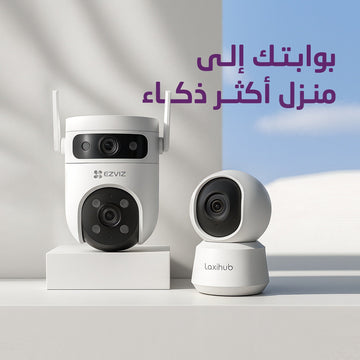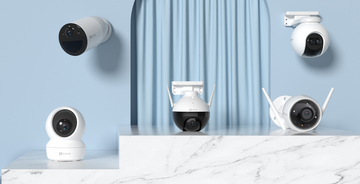

First: Determine the area you want to monitor
Before choosing a camera, ask yourself: Where will I place the camera?
Because the right camera for a child's room is different from the right camera for an entrance or courtyard.
📍 Indoor Security Cameras
If your goal is to monitor:
- Children's room.
- Living room.
- Home entrance.
- Elderly.
- Pets.
You can choose a small, easy-to-use indoor camera, preferably one with two-way audio so you can hear and speak to those present through the camera.
Some indoor cameras also offer pan and tilt and motion tracking capabilities, which helps cover a larger area and reduce blind spots.
🏡 Outdoor Security Cameras
If you want to monitor:
- House door.
- Courtyard.
- Parking lots.
- Entrance.
- Rest house or farm.
Choose a camera designed for outdoor use, with appropriate weather resistance.
For example, some EZVIZ outdoor cameras offer water and dust resistance ratings, in addition to night vision and human/vehicle detection.
Second: What camera resolution do you need?
Camera resolution directly affects the level of detail that will appear in the image.
The most common resolutions you will find are:
1080p → 2K → 2K+ → 3K → 4MP and others
However, choosing the highest resolution doesn't always mean it's the best option for you.
If you want to monitor a small room, a medium resolution may be sufficient.
But if you want to monitor a large area such as a courtyard or entrance, it is better to choose a higher resolution camera so you can see details more clearly.
For example, some EZVIZ cameras offer 2K or 2K+ resolution with digital zoom for reviewing details.
Our advice: Don't choose a camera based on resolution alone; also consider the field of view, lens, night vision, and smart features.
Third: Do you need night vision?
If the camera will operate 24/7, night vision is one of the most important specifications to consider.
There are cameras that offer:
- 🌙 Infrared night vision.
- 🌈 Color night vision.
- ⭐ Better low-light imaging.
- 🔦 Built-in lighting to aid night imaging.
Fourth: Does the camera move and track people?
If you want to cover a large area with a single camera, Pan & Tilt cameras might be a suitable option.
These cameras can move horizontally and vertically, and some models offer wide coverage of almost 360 degrees with the ability to automatically track people.
This makes them particularly suitable for:
- Halls.
- Courtyards.
- Entrances.
- Children's rooms.
- Large spaces.
Fifth: Choose a camera with smart features
Surveillance cameras are no longer just devices that record video.
Some cameras are now capable of using AI to help identify people or vehicles and send more accurate alerts.
Some features that might interest you include:
🔔 Motion alerts
👤 Person detection
🚗 Vehicle detection
🎯 Define monitoring area
🔄 Auto-tracking
🗣️ Two-way talk through the camera
These features help reduce irrelevant alerts compared to relying solely on motion detection.
Sixth: How will you store camera recordings?
Before buying a camera, don't forget to consider how the recordings will be stored.
The camera may offer one or more of the following options:
💾 MicroSD card
A practical option for local storage of recordings within the camera, with maximum supported capacity varying by model.
☁️ Cloud Storage
Allows saving recordings to the cloud and accessing them online, but services and availability may vary by product and market.
🖥️ NVR recording device
More suitable for those who want to set up a comprehensive multi-camera surveillance system.
Seventh: Do you need two-way audio?
If your goal is to monitor children or communicate with family members, this feature is very useful.
With two-way audio, you can hear what's happening and speak directly to the person in front of the camera using your mobile app.
For example:
Did your children arrive home from school?
Open the camera app, watch them, and talk to them directly, even if you're not home.
Eighth: Choose a camera according to your needs, not just the price
The cheapest camera is not always the best option, and the most expensive camera is not necessarily suitable for you.
Before buying, first determine:
Location → Area → Connection method → Resolution → Night vision → Storage → Smart features
Then choose the camera that combines the specifications you actually need.
🎯 Which camera is right for you?
For rooms and monitoring children:
Choose an indoor Wi-Fi camera with good resolution, preferably with pan/tilt, motion tracking, two-way audio, and local storage.
For entrances and courtyards:
Choose a weather-resistant outdoor camera with good night vision and person detection.
For large areas:
Choose a PTZ (Pan & Tilt) camera with a wide coverage angle.
For those looking for a wired connection:
PoE cameras are an excellent option, especially if network cabling is available.
For a comprehensive surveillance system:
It is preferable to choose a set of cameras compatible with an NVR recording device and determine camera locations before installation.
Conclusion
Choosing the right surveillance camera doesn't just depend on resolution, but on installation location, coverage area, night vision quality, connection method, storage, and smart features.
If you are torn between several cameras, don't choose randomly. First, define your needs, then compare the specifications that truly matter to you.
At Splus, you can explore a range of surveillance cameras, intercoms, and smart devices, and choose the right solution for your home and needs.
Do not hesitate to contact us if you need consultation, our team is always at your service.
Protect your home, keep your family safe, and stay always informed. 💜